Folketinget - The Danish House of Government
Denmark is a constitutional monarchy and is one of the world’s most politically stable democracies. The Constitution dates from 1849, when the King renounced absolute rule. The latest major amendments to the Constitution happened in 1953. The current monarch, Queen Margrethe II, nominally rules through the Prime Minister and his Cabinet. The Prime Minister is accountable to the Folketing, Denmark’s unicameral parliament. The Queen “chooses” the Prime Minister based on recommendations from the leaders of political parties. The monarch can, on rare occasions, grant pardons, however judicial power rests solely with the courts.
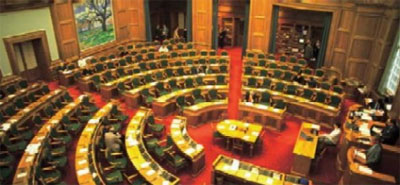
The Chamber of the Folketinget
Denmark has a lengthy history of minority coalition governments. The Parliament is elected for a four-year term and has 179 members including two memers each from Greenland and the Faeroe Islands, which are home rule territories of Denmark. Parliamentary elections are often held before the nominal four-year terms are up, either because the Government loses in a “vote of no confidence” or because the Prime Minister calls an election to improve the ruling coalition’s parliamentary position.
Voter participation in general and municipal elections frequently exceeds 80%. Cabinet ministers need not be members of Parliament. Ministers have no political Deputy Ministers or Secretaries of State as in other parliamentary democracies. Rather, they have a Permanent Under Secretary (in some instances more than one), who is the highest-ranking civil servant within the ministry. There are very few political appointees among the civil servants, who remain largely unaffected by changes of government. Four Danish political parties have a parliamentary history of 80 years or longer. Political parties play a significant role in Danish politics.
Parliamentary seats are allocated following elections based on proportional representation. Members of Parliament strongly represent their political party’s policies and are supported by their constituents based on the party platform. Members of Parliament do not have staffs provided by the state (nor, for that matter, do parliamentary committees), only secretarial assistance. As a result, Danish parliamentarians must rely on their parties for support and technical expertise on legislative issues. Party discipline, as a consequence, is very tight.
LastUpdate: 2015-04-09 14:03:14