
The Viking Longhouse
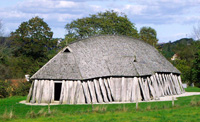 Life inside a Vikings Longhouse would have been a noisy, dirty experience. First of all many Viking families would be living together in the same house.
Viking homes were long rectangular buildings. Often one end of the longhouse was used as a barn. The barn end of a longhouse would have crops stored, and it would usually be divided into stalls for cattle and horses. By living under the same roof as their animals the Vikings were able to secure a constant source of heat (a rather noisy one). It also ensured that the animals were kept safely away from cattle thieves. A cow was a valuable form of income.
A fireplace would be somewhere in the middle of the floor. The fireplace would be used for heat, light and as cooking facilities. There would not have been a chimney, so the entire building would have been quite smoky. The smoke from the fireplace would only be able to escape from gaps in the roof; whether the roof was made of thatch, peat or wood shingles, depending on the local materials.
Benches would have run along the walls. These benches were usually an integral part of the structure of the entire building. They would help reinforced the base of the walls. There would not have been much else for furniture other than the benches. The benches would function as both bed and as sitting accommodations during the day. Simple forms of craftsmanship such as spinning, weaving and basketry could be performed on the benches. Some farms had separate buildings for different activities. Several forges have been found in some farms throughout Denmark, and the majority of the forges are not located in the main building.
Viking homes within towns did not have the need for as much space for the storage of crops or for cattle, so they were shorter than country homes. The best evidence we have for Viking town houses comes from the Viking Age town of Hedeby, Germany. The houses in Hedeby were rectangular, and they were about 12m long by 5m wide. Country homes throughout the Viking World range from 30-60m long by 5m wide. The longest known longhouse was found near Lofoten, Norway and it had a length of no less than 83 meters. One of the homes found in Hedeby had an oven for cooking food. However, this was most certainly not the norm during the Viking Age, and the presence of a separate kitchen is actually quite odd.
LastUpdate: 2016-10-04 08:37:33