
Types of Viking Ships
Viking Ships represented the height of technology of the day. The Vikings were brilliant ship designers and builders, and designed different types of ships for different purposes.
Evidence of the many Vikings ship types comes from randomly discovered ships in burial sites and from Viking ships which have wrecked. One of the best sources of knowledge of Viking ship types comes from vessels which appear to have been sunk on purpose harbours in an effort to strengthen the defences of Viking Age seaports. The best example of the latter is the 5 Skuldelev ships which were discovered in Roskilde Fjord in the 1960's. These ships were intentionially sunk to blockade part of the fjord in the early 11th century. The 5 five ships are now on display at the Roskilde Viking Ship Museum.
Warships – Longships 3 Types (Snekke, Drekkar, Skeid)
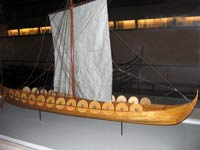 Snekke Viking Ship Model - Roskilde, Denmark |
Two of Skuldelev ships were Viking warships, and with another warship finding from the port in Hedeby. This constitutes three very valuable sources for our knowledge the Viking Longship (Warship). All 3 ships had a shallow draft; they are all long (30 meters in one particular case from Skuldelev) and narrow. Most importantly they had room for up to 18 pairs of oarsmen. The Warship appears to have been built primarily as a row boat, however it did have sails which could be hoisted and lowered as needed. The oars gave added speed and manoeuvrability for difficult situations. This would have been the main type of ship the Vikings used in their surprise attacks on the villlages and monasteries of Western Europe.
While Viking Ships had ravaged Western Europe for centuries they inevitably disappeared from use as they were slowly replaced with more modern vessels.
When did Viking Ships Disappear from Use?
Heavy Freight-Carrying Merchant Ships – (Knarr)
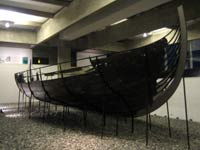 Knarr Viking Ship - Roskilde, Denmark |
The blockade in Roskilde Fjord also contained two ships which were clearly Viking merchant ships. The largest was 16.5 meters long, built of pine and it could carry up to 40 tonnes of goods. Traces of similar merchant ships have been found in Åskeskårr in Western Sweden, near Kaupang in Norway, and in the harbor of Hedeby. All these ships have similar characteristics. They were all broader in proportion to their length than the warships. They had a wider and deeper hull for cargo, and they were clearly much more dependent on the sail than the oars. Speed for these vessels was clearly not a priority. The real priority was to have a seaworthy vessel which could cross vast stretches of ocean without wreck. The oars would probably only have been used to help the ship in and out of harbour. These ships probably operated along the coasts of Scandinavia and in the open seas to the west.
Light Freight-Carrying Merchant Ships – (Byrding)
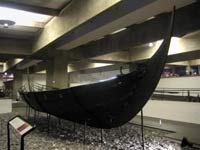 Byrding Viking Ship - Roskilde, Denmark |
The needs of the warriors and merchants who sailed to Eastern Europe had different needs. They needed lighter more manuverable ships which could navigate their ways through the Russian rivers to Byzantium and the Caspian Sea. These ship types would also have to be light enough to be pulled out of the water to be portaged over rocky areas, shallow areas and other obstacles.
Of course these ships were used all throughout Viking Age Scandinavia, however they were of greatest importance in Eastern Europe.
Small Boats
The vast majority of boats which were used during the Viking Age were neither warships nor merchant ships. They were small boats which were needed for day to day life..., boats designed for fishing, transporting people, goods and local news from one settlement to another. Some of these boats would need to travel along the coasts while others would need to travel through the network of rivers and lakes in Viking World.
The Viking ship and Viking boats were the vital key to the power and expansion of the Nordic peoples.
LastUpdate: 2019-06-26 19:04:03